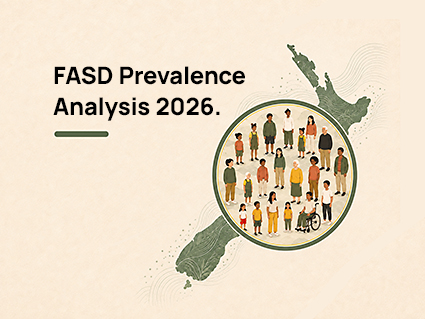
Fetal Alcohol Spectrum Disorder (FASD) is recognised as one of the leading causes of lifelong neurodevelopmental disability in many Western countries. In Aotearoa New Zealand, however, no national prevalence study has yet been completed.
This means we rely on a combination of local research, international evidence, and statistical modelling to estimate how common FASD is likely to be. Despite a study being noted as a core component of the FASD Action Plan 2025-2028, no study has yet been done.
We know that alcohol use during pregnancy (prenatal alcohol exposure, or PAE) occurs in Aotearoa. Studies suggest that between 18% and 28% of pregnancies involve some level of alcohol exposure. These figures are likely underestimates, as alcohol use during pregnancy is under-reported due to stigma and recall challenges.
The Ministry of Health / Manatu Hauora have for years relied on a range of 3%-5% of babies born each year with FASD – and we’ve always used this figure, too. However one more recent estimate was 3.9% (3-5%) for the general population and 6.3% (4.8%-8.0%) for Māori. Yet another study [Romeo et al (2023)] estimated 1.1% and 1.7% respectively.
Although there were significant limitations which were noted in this study by the researchers themselves, we have noticed the figure of 1.1% is starting to be used.
FASD-CAN is concerned about the use of this figure as it does not take into account that it’s likely to be a significant underestimate of prevalence. So we decided to conduct our own prevalence analysis – while allowing that any study will only ever be an estimate, due the limitations of data noted above.
Dr Leigh Henderson, co-Chair of FASD-CAN has compiled and re-examined all the relevant data available up to March 2026, to produce an estimate which can be used in considering policy and funding decisions relating to FASD.
We consider the best current estimate of FASD prevalence in Aotearoa New Zealand to be between 2–5% of the population.
Using the number of live births in 2025 of 57,705 with the upper percentage estimate, that’s 8 babies per day. This means FASD is likely more common than many people realise, and may affect many more people than more well-known neurodevelopmental conditions do.
It highlights the importance of increasing awareness, improving prevention efforts, and ensuring the right supports are in place for people with FASD and their whānau.
Access FASD-CAN's prevalence analysis document here.