Pregnancy healthcare providers represent the best opportunity to help avoid Prenatal Alcohol Exposure (PAE) and subsequent FASD. However, if exposure does occur, the role of GPs, Paediatricians, and nurses (especially Child Health Nurses like Plunket and Well Child providers) shifts from primary prevention to developmental surveillance and vital early identification after the pēpi / baby is born.
Early Physical Assessment and Developmental Surveillance
Less than 10% of babies are born with the three distinct FASD 'sentinel features' (small eye openings, flat/long philtrum, very thin upper lip). Their presence is an indication of PAE, but most people with FASD do not have these features. The presence or absence of these features does not indicate how severe or mild the disorder is for the FASD person.
As an individual grows into adolescence and adulthood, these features can become less distinct. However, other physiologocal and cognitive challenges do not diminish even if the facial features become less apparent over time.
Other potential early physical signs that doctors and Child Health Nurses monitor may include: low birth weight, small head size, or slower physical growth. Crucially, these signs trigger close developmental surveillance for global developmental delay against established child developmental milestones.
Whole-Body Understanding
A growing body of research, including a study released in June 2025 by the University of Queensland, confirms that FASD is a whole-body diagnosis affecting metabolism, cardio-renal, immune, reproductive health, hearing, vision, and sleep. This reinforces the need for a holistic and lifelong approach to support.
Long-term physical challenges
People with FASD are many times more likely to be diagnosed with physical health conditions than the general population. Common co-morbidities include:
- Motor skill challenges
- Cardiac / heart defects
- Joint deformities or abnormalities
- Hearing and vision issues
- Dental issues
- Bowel and bladder functionality
- Congenital and chromosomal conditions
- Inflammation – early-onset problems with arthritis and other inflammatory diseases.
Recent research
Beyond the Brain: The Physical Health and Whole-Body Impact of Fetal Alcohol Spectrum Disorders
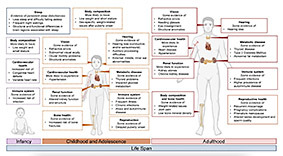
A study by the University of Queensland in June 2025 concluded that FASD is a whole-body disorder.
"A growing body of evidence suggests that individuals with PAE/FASD experience multiple comorbidities relating to metabolism, cardio-renal, immune, and/or reproductive health, hearing, vision, and sleep difficulties. These findings support the concept of FASD as a whole-body diagnosis, emphasising the importance of a holistic approach that supports the overall health and well-being of those with FASD. There are opportunities for future clinical research to focus on further understanding these physical health challenges, how they evolve, and how effective intervention approaches could improve outcomes for individuals with FASD."
This chart from the report is very helpful – click here, or on the picture to access a full-sized, downloadable version.
Click here to read the full paper.
The 'Lay of the Land' survey (2020)
This important research paper, developed by International Adult Leadership Collaboration (ALC) FASD Changemakers (Myles Himmelreich, CJ Lutke and Emily Travis-Hargrove, three adults with FASD), reports the results of a community-based health survey which interviewed over 540 people with FASD. The findings dramatically demonstrated that Fetal Alcohol Spectrum Disorder (FASD) is indeed a 'whole body' diagnosis. An understanding of these results will ensure timely and appropriate diagnosis and treatment for individuals with FASD.
Note: This report is currently only available as a chapter in a book – The Routledge Handbook of Social Work and Addictive Behaviours (Chapter 12). This book is available at the IHC library in Wellington (they can post it out if you order online).
Webinar – FASD: a whole-body diagnosis (90 mins)
A webinar discussing the above research aired on International FASD Awareness Day 2021 and featured Myles Himmelreich, along with clinicians and a parent advocate. It was hosted by Surrey Place, a not-for-profit organisation for neuro-developmentally challenged people in Toronto, Canada.
Click here to watch.

