"Hei te tau tītoki / The tītoki blooms in its own time."
FASD-CAN supports a group of rangatahi / young people and adults living with FASD via a globally-innovative, co-led programme of events that the cohort has named ‘Tītoki’ (previously IDP – Individuals Development Programme).
Tītoki is a FASD-CAN programme of events which has evolved since 2023 and aims to foster whanaungatanga, connection and friendship for people with FASD. Through it, participants have been gaining mutual āwhi / support, encouragement and an increased sense of mana.
The programme is now evolving, by their request, into strengthening their knowledge and skills to enable them to advocate for their own rights and needs, as well as those of their supporting communities and their whānau.
All our Tītoki events are funded, although koha are always welcome to help us continue the programme.
Overview of Tītoki activities
 Pizza Clubs
There are regular get-togethers in Tāmaki Makaurau, Kirikiriroa, Pōneke and Ōtautahi (Auckland, Hamilton, Wellington and Christchurch) which usually include an activity such as bowling, mini-golf or laser tag.
Weekend camps
Our rangatahi / young people wanted to build a wider FASD community, so FASD-CAN runs a bi-annual weekend camp at El Rancho, an outdoors conference centre north of Wellington (photo above – March 2026, click for larger version).
There are activities such as kayaking, climbing, archery, swimming, walks – and always a bonfire with marshmallows. Participants can also learn about how and why their own brains work differently, as well as strategies for self-awareness and self-regulation. These discussions build self-confidence and develop self-expression – and for some, kaiārahi / leadership skills. Essential space for downtime is always factored in.
Each person with FASD is able to bring a support person, parent or caregiver with them, and Tītoki events are also opportunities for these supporters to connect, share their stories, learn more about FASD and create their own important networks.
At time of writing, we believe the format and kaupapa / purpose of these camps is a global innovation unique to Aotearoa NZ.
Tītoki Kaupapa
These statements were created with workshopped input from participants:
- We are a diverse, multi-cultural group of individuals with brain differences resulting from pre-natal alcohol exposure.
- We want to create opportunities for us to plant our feet firmly with pride, confidence and certainty.
- We stand together with courage.
- We grow our mana, our connections and our leadership skills so our whānau and communities can hear our voices and improve their knowledge and understanding of FASD. We want our voices heard to bring about change.
Opportunities for self-advocacy
Some kaiārahi / leaders have appeared in videos, met with policy-makers in Government, presented at conferences and contributed lived-experience to training and webinars.
These opportunities for self-advocacy are driven by their growing awareness of the lack of understanding of FASD across education, justice, health and policy, as well as among the general public. The group recognises they are the experts in FASD, and FASD-CAN supports them and their whānau /families in this.
In March 2025, the group shared their experiences, guided by facilitator Mike Sansom: stories of misunderstandings in education and services, barriers to diagnosis, and inequitable access to the support which is available to others with similar disabilities. Most of all, they felt unheard: “The system is failing us.”
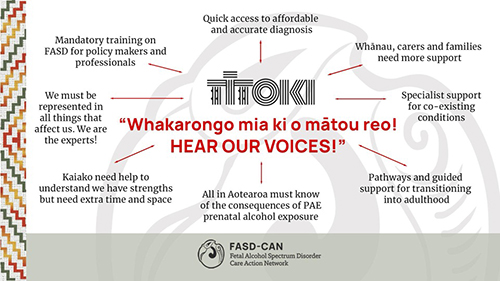
This led to a manifesto of 8 key messages on FASD for policy-makers, devised through living experience to enable better lives for them and for their families.
The 8 Key Messages
- Mandatory FASD training for policy makers and frontline professionals.
- Quick access to affordable, accurate diagnosis.
- More support for whānau, carers and families.
- Specialist support for co-existing conditions.
- Supported pathways into adulthood.
- Public awareness of prenatal alcohol exposure.
- Schools to understand that ākonga/students with FASD need time and space.
- Representation in all decisions affecting us. WE are the experts!
The rangatahi know they can use the 8 Key Messages in any situation, around the dinner table with whānau, amongst friends, talking to a teacher or social worker, interacting with the media, policy makers or MPs – knowing that others are saying the same thing.
Click here or on the image below to find out more and to download a pdf of the 8 Key Messages.
Facilitators
Anna Gundesen, FASD-CAN Navigator in Tāmaki Makaurau / Auckland and training facilitator, is our project lead for Tītoki.
Mike Sanson is a key facilitator for Tītoki. Mike is a highly experienced international development specialist who has worked for years in the social inclusion and disability space at policy level.
Kelly Archer is our Tītoki Youth Development Kaimahi, organising everything that goes on behind the scenes for the camps and more.
The original kaiārahi or leaders with lived experiencee were Byron Jones, Teowai Te Moana Clayton and Noah Langdon-Reidy – exceptional young people who helped develop the activities for the early weekend camps.
We couldn't present our weekend camps without other FASD-CAN kaimahi / staff, volunteers from other organisations, parents, caregivers and guest mentors as available, and we thank all of them.
Tītoki branding
In 2025 the group developed a name, and with support from FASD-CAN board member Darryl Roycroft, a visual identity.
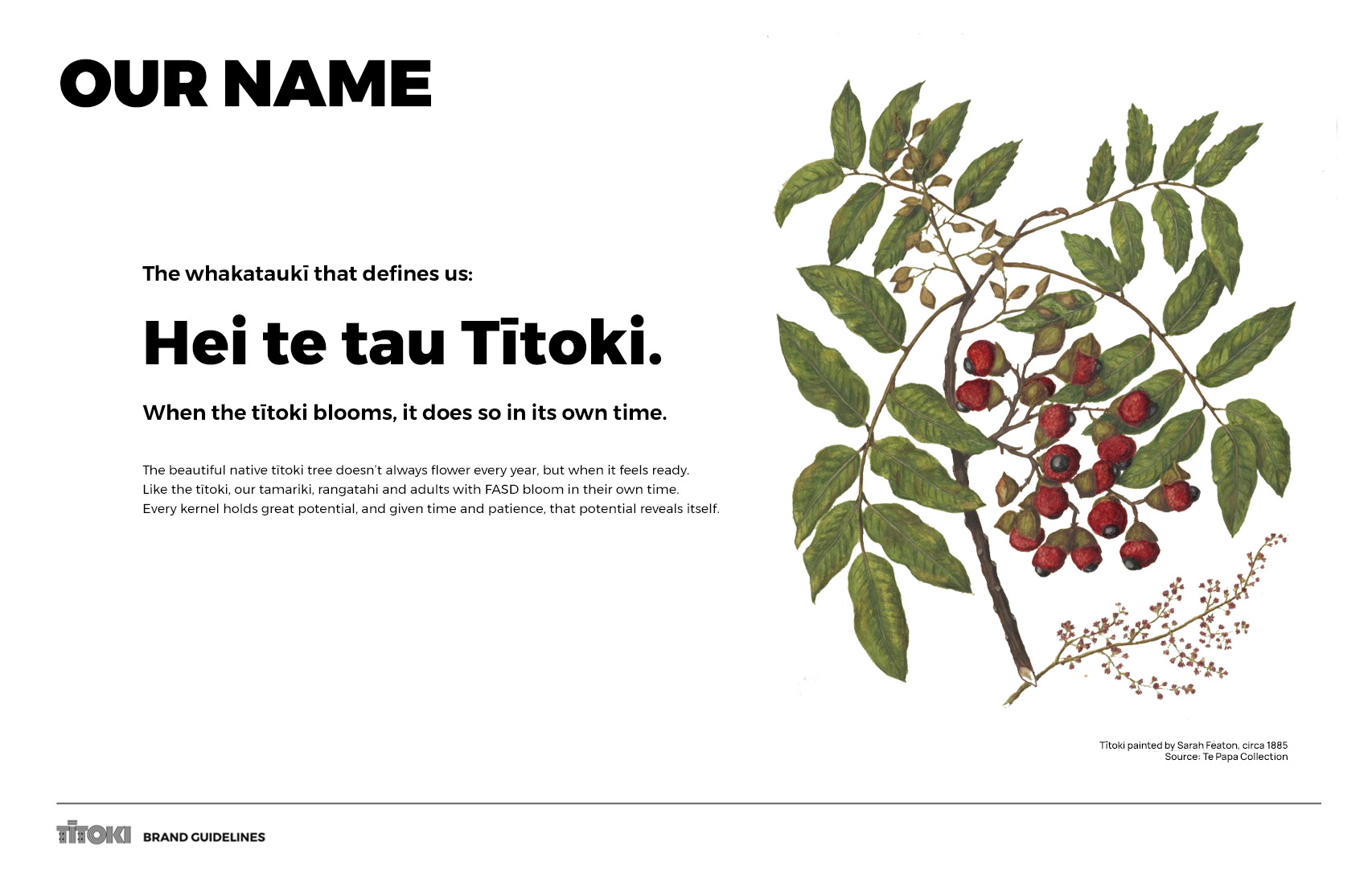
The name comes from the whakataukī / proverb: Hei te tau tītoki / The tītoki blooms in its own time. This also applies to people with FASD.
A logo and four graphic elements were created for use across design work.
Click here or on the image below to check out our brand story.
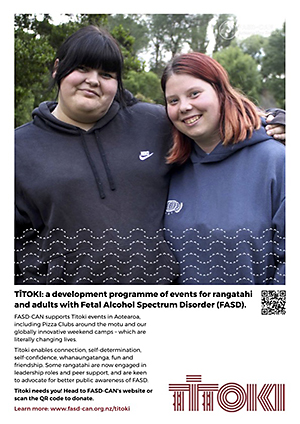
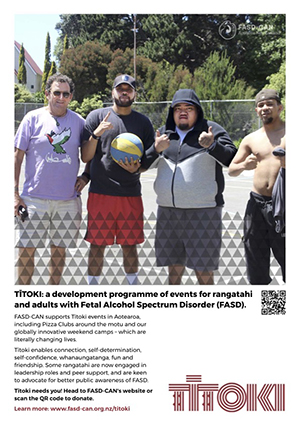
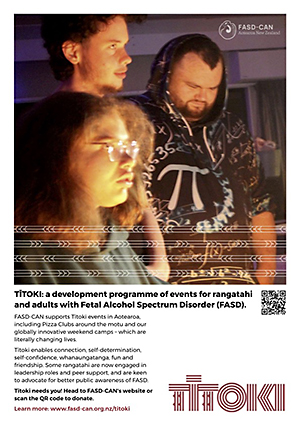
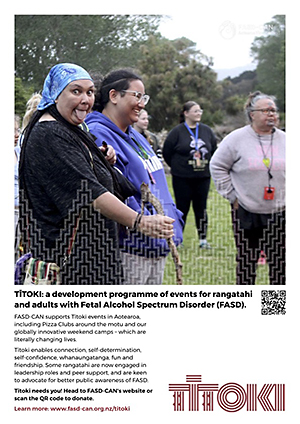
We have created four posters for Tītoki which can be used anywhere. The beautiful photos in these posters were taken by Jackie (first photo, left), one of our rangatahi with FASD, in November 2025. Jackie was the official photographer for the November 2025 weekend camp.
Click on the thumbnails below for bigger versions.
The Impact of Tītoki
The FASD community is now a growing movement – Tītoki is a space where young people with FASD feel accepted with no judgement. They have an extraordinary compassion for each other and evidence of growing courage as they share their own stories of struggling in a world that 'doesn’t get them'.
Perhaps the strongest indicator of the success of Tītoki is the energy and engagement at every camp, the enthusiasm for the next one and the increasing numbers who want to participate.
Byron, one of the main kaiārahi / leaders, is happy: “We are building an FASD community, an FASD whānau. This is what we need.”
Georgie, an emerging leader, has written to six government ministers telling them of her lived experience of FASD and of being in care. Her email says, “I ask respectfully that you allow space for lived experience to inform national decision-making. Those who have walked through the system carry insights that statistics alone cannot provide.”
As the project lead, Anna, has observed, “Each camp has been wonderful in its own right. It's incredible to see how much growth and confidence is emerging. We need a secure future of ongoing Tītoki events to foster this.”
Conclusion / What’s Next
There is no doubt that Tītoki has changed lives – and we feel it’s essential that it can continue to do so. Many participants are now asking for more information on the impact of alcohol and brain development. Other requested topics include self-awareness of how FASD is affecting them; information on substance use and addiction; skills and resources to strengthen their voices; more activities to build confidence and more opportunities for advocacy. And of course more opportunities to hang out with their friends! Watch this space.
Further information / contact
Please join us as a member to receive our monthly e-news, and follow us on our social media (Facebook and Instagram) to stay updated. If you'd like to know more about our Tītoki programme, or ensure you are contacted the next time we hold events, please email our Tītoki Coordinator at [email protected].
Tītoki video
This video was made in 2025 and features some of the rangatahi and their whānau. It won runner-up in the inaugural FASD Film Festival in Canada.
Watch the award-winning film below (10 mins).
Previous events
Click below for roundups, photos and reels of our previous Tītoki events.
March 2026 (Instagram link)
November 2025
February 2025
September 2024